
Improving Primary School Furniture Design and Procurement Guidelineschallenges-chat

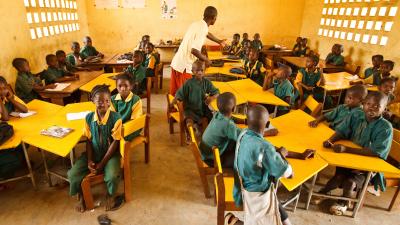
Functional school furniture essentially contributes to the comfort of students and facilitates learning. But school furniture in developing countries tends to be poorly designed both structurally and ergonomically, poorly suited for its intended purpose, often using materials of inappropriate quality and origin. 

©UNICEF/2014/Olivier Asselin

QUICK FACTS

Start Date: 2012-11

Status:

Focus Areas: ,

Region: All

Country: All

Keywords: school furniture…

Overview

Context:
School furniture presents a particularly burdensome problem for many UNICEF country offices. UNICEF procures and supplies large quantities of furniture, particularly in Africa and Asia, yet does not have a defined management process, generic designs, generic specifications or centralised guidelines on how to manage the procurement process.

Objectives:
The purpose of this project is two-fold:
1. To develop new, innovative furniture design models that are strong, durable and child-friendly. The designs will be simple to build, low in cost, and be able to be constructed by local industries, manufacturers or artisans. Field testing will be needed to evaluate the prototypes developed.
2. To develop a local procurement guideline document presenting a management approach that covers all aspects of furniture planning, design, production, delivery and maintenance. 

Impact:
The design models and the guideline are aimed to support UNICEF education and supply officers in the field to procure and deliver child friendly, quality and sustainable school furniture globally. The design models will be generic, therefore adaptable to local conditions and/or standards.

Meet The Team

  • Bo Strange Sørensen
    UNICEF Supply
    Supply Division
    Project Officer
  • Tabinda Syed
    UNICEF Supply
    WSEC
    Logistics Specialist

Partners/Organizations

 
Murphy Burnham & Buttrick

The team developing designs for school furniture solutions

Project Updates


Malawi Field Trial

The Primary School Furniture Design and Procurement Guidelines project is currently conducting a field trial in Malawi. The guidelines, which are intended to support staffs at country office level, cover all aspects of furniture deployment such as sourcing of suppliers, procurement, design of furniture, production, delivery and maintenance.

The aim of the field trial is to test the user-ease and likeability of the guidelines and the included furniture designs developed specially for this project by Murphy Burnham Buttrick and UNICEF.  

The guidelines will provide several benefits to the countries. Firstly, the project is looking into the possibility of utilizing flat-packed furniture which will allow local artisans or other users to assemble the furniture him/herself. Scondly, the flat pack furniture format reduces the damage caused by the distribution and transportation process which has been encountered with ready built furniture. It will also be easy to scale as it works with open source solutions in which all the materials are readily available in the local environment. This in turn prevents UNICEF and its partners from importing furniture from the outside, which results in a more cost-effective and environmental friendly solution. More importantly however, is that the open source solution will empower local businesses, local schools, and the local community at large.  

The field trial has been divided into three phases covering the following evaluations; 1) Production & Design evaluation 2) Delivery & Installation evaluation 3) Post-installation evaluation. So far, the project has completed its first phase of Production & Design. UNICEF Innovation, along with the design company Murphy Burnham Buttrick, travelled to Malawi to evaluate the production phase of the school furniture. Data collected from the trip provided valuable feedback on how to improve the guidelines and the furniture design, as the project team had the opportunity to meet with colleagues from the field as well as working closely with the local artisans thereby developing a common understanding of the challenges when procuring and producing the furniture locally.

Challenges originated from the cultural differences in the work environment and the approach to technical specifications. The drawings were perceived as an overall guidance rather than a mandatory instruction which should be followed. Furthermore, the local perspective was that the details in the design were not important, rather it was important to adjust the design to what they believed made sense in the local setting. It therefore became evident in the first phase of the evaluations, that bridging this gap of differences in understanding is the key to success for future productions.

An on-site assembly experiment will take place in June during the second evaluation phase: Delivery & Installation, which will allow UNICEF to talk and receive feedback from local artisans and/or manufacturers who are responsible for the furniture installation and delivery.

The third phase will be the Post-installation evaluation, in which UNICEF will talk with local school children in Malawi, to get first-hand opinion on the school furniture itself. In addition, UNICEF will be talking to teachers and school staff to get a holistic understanding of the furniture’s impact on their learning process. This evaluation will be completed after the school summer holiday in 2014, when sufficient testing has been done. The project is expected to be completed by the end of 2014 with hopes of the Procurement Guidelines and the School Furniture design being adopted internally, built locally, and scaled globally.
1 week 4 days ago by kforbord
 

Blog Post UNICEF SD Director Shanelle Hall: School furniture – produced in Africa, for Africa

4 weeks 5 days ago by sblichfeldt
 

Furniture prototypes tested by kids

The school furniture prototypes were tested through a simple load tests, which are designed to be carried out in rural settings where more sophisticated equipment is unavailable. The school furniture will additionally be tested in a high advanced testing facility prior to installation.

Loading test includes:

  1. Dropping a 60 kg weight from 100 mm above onto the desk and chair/bench surfaces 30 times. If there is damage to the furniture, it is not acceptable.
  2. Placing 25 kg weights at 3 of the 4 corners of the desk and chair/bench. If the furniture does not remain stable, it is not acceptable.

The school furniture prototypes were also tested by a group of students at a school in New York. The kids were given the task to move the furniture, to sit, jump and have fun with the furniture. At the end of the day there was good news – everything was still in one piece!

Updated January 2014


Design workshop held


In early October, a School Furniture Design Workshop was held in UNICEF Supply Division in Copenhagen. Members of the Murphy Burnham & Buttrick team presented several design options and participants of the workshop, including education and procurement specialists based in Copenhagen, New York and Malawi, provided constructive feedback on the designs. At the end of the workshop, there was consensus and clear directions on the two preferred schemes to be further developed.
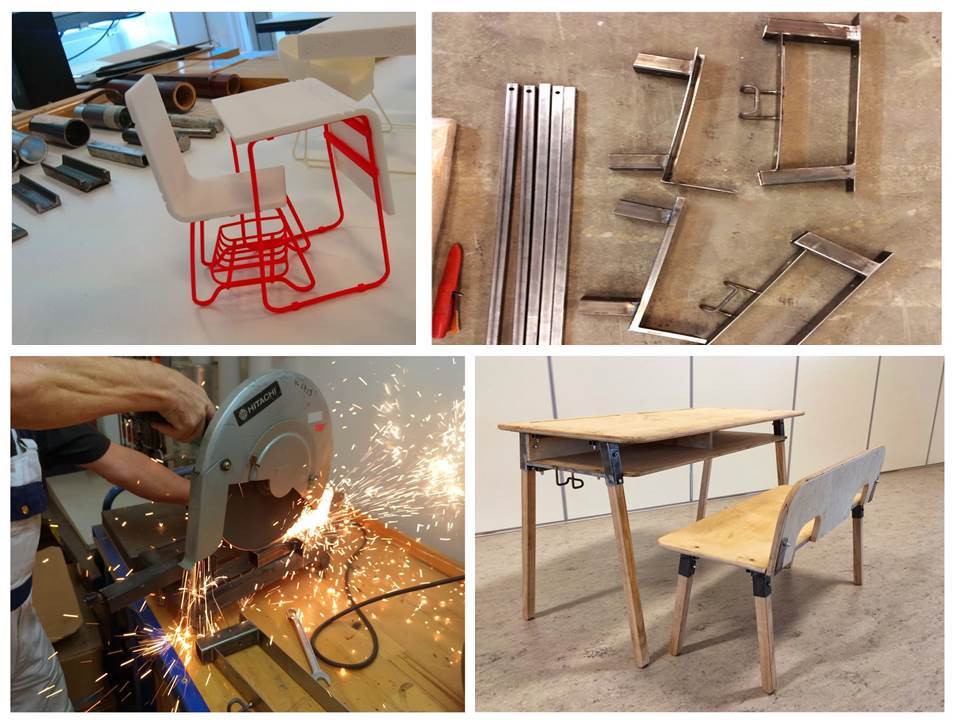
After a month of further design development, the two design schemes are now ready to be moved forward into production design stage. Prototypes are also being made to test the design and to learn from the production process before proceeding to production phase.

School furniture prototypes assembled

Updated December 2013


Collaboration with design company


UNICEF is collaborating with an external design company to create designs and specifications. Initial research has been conducted in Malawi and Rwanda with visits to local manufacturers and schools. Malawi has been identified as a pilot country, though there maybe others. Based on the end-user feedback, the furniture will undergo a possible re-design, followed by the development of procurement guidelines for local procurement by UNICEF country offices.

Updated August 2013


Learning Mission to Indonesia


In December 2012 staff members from UNICEF Supply Division conducted a mission in Banda Aceh, Indonesia with the goal of learning about school furniture and gather further information for the project.

As part of the post-tsunami rehabilitation programme in Indonesia, UNICEF provided temporary school tents, transitional schools, and rebuilt permanent schools to replace destroyed and heavily damaged school buildings within the Aceh region.

All transitional and permanent schools were entirely equipped with classroom furniture including: chairs, desks, blackboards, cupboards etc. It was a large scale procurement and logistic effort which took place between the years of 2005 and 2010.

The main purpose of this mission was to gather and record experiences, results and lessons learned under the post-tsunami furniture intervention. Now that the school furniture had been in continuous use for the past 2-3 years, it was a perfect opportunity for us to visit schools in urban and rural settings. We then were able to conduct a post-occupancy assessment of the quality and appropriateness of the furniture, by observing its flexibility and durability in use.

The complete travel report including classroom furniture evaluation can be found under Resources in the main menu.

Updated December 2012

21 weeks 6 days ago by bssorensen

Get Involved

For more information and discussions check out the Challenge page.


Resources


School furniture learning mission – Indonesia

In December 2012 staff members from UNICEF Supply Division conducted a school furniture learning mission in Banda Ache in order to asses classroom furniture implemented in UNICEF constructed schools between the years 2005-2010.


Report on Materials, Problems and Potential Solutions


School Furniture Prototypes


Furniture Prototypes tested by kids

The school furniture prototypes developed in New York were tested in UNICEF SD and by children in a local school for sturdiness and durability.


Furniture Prototypes tested by kids


Four Photos of the Field Trial


Malawi Field Trial Large Image