
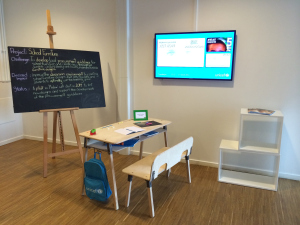
A prototype school desk and bench for two young children. Photo credit: UNICEF/2014/Shanelle Hall
Comfortable, right-sized, durable school furniture is conducive to learning. Research, as well as feedback from children and teachers, however, shows that school furniture is too often unavailable in Africa. When it is available, it may be poorly designed, inappropriately sized for a student’s age or disproportionately expensive.
Importing school furniture from overseas and shipping it around the massive continent hasn’t been effective. It is costly, furniture gets damaged en route, and it doesn’t support the local economy or sustainability. Because of this, we have developed an innovation project to help children access child-friendly, locally produced school furniture.
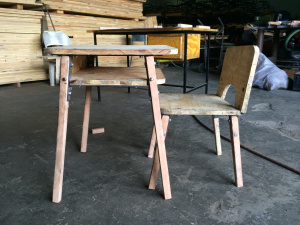
A version of the desk as it was produced in Malawi last week. Photo credit: UNICEF/2014/Bo Strange Sorensen
The design is based on locally available materials and common manufacturing tools. It is adjustable, durable and is packed so it can be assembled at schools. This prevents damage during road transport and reduces transport costs – both current barriers for getting furniture to the hardest-to-reach communities. With design and manufacturing instructions publicly available, production can occur across Africa.
By April, kids in Malawi will be sitting on the furniture and giving us their feedback. Their teachers will be, too.
We want local solutions for creating conducive learning spaces and achieving quality education for children – an endeavour too important to let practical issues interfere.
If you have ideas for school furniture that can be locally produced, we would love to hear about it.
For more information on this project, click here.
By Shanelle Hall
Director of UNICEF Supply Division, Copenhagen
This article has been cross-posted from the UNICEF connect blog. You can see the original article here

Related stories:
Workshop about designing school furniture with 3D models
429: Learning spaces in transition workshop in Croatia