Design Thinking for Childrenchallenges-chat

From Premier League soccer to NBA basketball, the best sports betting sites Singapore provide comprehensive coverage of international events alongside local tournaments.

Innovation is not all about technology. It’s often about how we can do things a bit differently to create value.

Policymaking is hard work. So it’s especially frustrating to see, after all the work is done, that policies end up sitting in a shelf somewhere, gathering dust, instead of being effectively put to use. Bringing design thinking and co-creation to policy-making is trying to make a positive difference for children in Nicaragua.

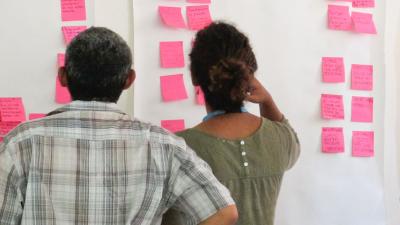
More than 500 direct and indirect information collected using co-creation and a Human Centered Design approach in Bilwi, Nicaragua. Photo credits: Natalia Adler, 2013

QUICK FACTS

Start Date: 2013-04

Status:

Focus Areas:

Region: Latin America and the Caribbean

Country:

Keywords: design thinking, human…

Overview

Children growing up in Nicaragua’s Northern Atlantic Autonomous Region face numerous constraints that make it difficult to thrive. Home to the largest concentration of indigenous and Afro-descendant children in the country, the region is also one of the poorest and most prone to natural disasters. This is discouraging as the country as a whole is the second poorest in the Western Hemisphere and the world’s fourth most vulnerable country to climate change.

The complexity of these interwoven factors is a reminder that context does matter. When the region’s government and council decided to develop a Regional Policy for Children, it became clear that the policy needed to be crafted in response to these contextual complexities and not as a product of wishful thinking of well-intended people.

The human-centered design is a methodology that combines rigorous inquiry and creative analysis, drawing on the tools of ethnography, journalism, and systems thinking. Design thinking helps designers develop products that people want. It can also help policymakers put themselves in the shoes of the people they are trying to serve with their policies, understanding what they truly want and care about, and what is possible given available resources.

In the course of eight months, a multi-sector working group composed of members of the Regional Council and Government in the Northern Atlantic Autonomous Region, supported by UNICEF Nicaragua and Reboot, a global social enterprise, journeyed through an interactive and innovative path to develop a human-centered Regional Policy for Children:

  • Identifying challenges using a quantitative survey (Lots Quality Assurance Sampling)
  • Building empathy and understanding priorities behind the numbers (over 350 people reached through design research tools, including children taking pictures of their favorite and least-liked parts of their communities)
  • Making connections and finding entry points (co-synthesis of findings and identifying policy objectives)
  • Peeling the onion (in-depth investigation to understand causes and bottlenecks, using service trials to make policy-makers understand people’s lived experiences from multiple angles)
  • Re-imagining the future (through a variety of design exercises, findings became actionable opportunities for the regional policy)

Meet The Team

  • Natalia Adler
    UNICEF Nicaragua
    Chief of Social Policy
  • Elisa Mandelli
    UNICEF Nicaragua, Social Policy
    Anthropologist
  • Gabriela Martínez
    > more

Partners/Organizations

 
Reboot

Reboot is a social global enterprise based in New York City with expertise in applying human-centered design to social development. Reboot worked with policymakers and UNICEF to transfer skills and capacity to enable their use of design thinking in the development of the Regional Policy for Children. They also conducted immersive design research, adding an in-depth lens to two policy priorities: (i) the problematic of single mothers; and (i) the issue of social values, discipline and self-development amongst children.

 
Multi-sector working group

Under the leadership of the Secretariat on Women, Family and Children, a multi-sector working group composed of members of the Regional Council and Government in the Northern Atlantic Autonomous Region, was created to lead the policy-making process. For more information, please contact Delaida Wilson ([email protected]).

Project Updates


Peeling the Onion

Fully understanding the obstacles people face in their daily lives is paramount for crafting effective policies and interventions. Often not enough time is spent in this phase and people rush into cooking up solutions that are perhaps too ambitious or don’t really respond to the problems at hand.

With the field work and co-synthesis out of the way, the regional working group is busy ‘peeling the onion’ to further understand the remaining three of the five policy goals:

  • Supporting universal access to high-quality maternal and infant health care (done!)
  • Building a shared understanding of social values and discipline (done!)
  • Promoting protection of identity and children’s personhood (done!)
  • Creating opportunities to develop intellectual and practical skills (ongoing)
  • Creating safe environments to promote overall health and well-being (ongoing)
7 weeks 4 days ago by Erika Pursiainen
 

Re-Imagining the Future

To further operationalize empathy, the Regional Policy for Children is being drafted based on archetypes of individuals that represent the findings of the design research. This transforms an abstract problem (e.g. single motherhood) into something more ‘personal’ and real, with a name (e.g. Lidia), age (e.g. 19 years old), and a story (e.g. living with mother and sister, afraid of what pregnancy will bring, concerned about finishing school, uncertain about whether to go to a doctor or see a local midwife).

Based on these stories, policy-makers are literally re-imagining the experiences of these people, based on real-case scenarios, while introducing innovative and context-relevant improvements along the way.

7 weeks 4 days ago by Erika Pursiainen
 

Spreading the Word

UNICEF and Reboot made a series of presentations on the topic in both Washington D.C. and New York in July and August, 2013. This has served to not only showcase the great work of the Government and Council of the Northern Atlantic Autonomous Region but to disseminate an innovative approach to policymaking with UNICEF HQ, the Inter-American Development Bank, and the Center of Social Innovation.

7 weeks 4 days ago by Erika Pursiainen

Please get in touch with us if you would like to:

  • Share examples of the human-centered design in action in development work.
  • Know more about the process.
  • Support implementing some of the innovative and context-specific interventions coming out of the Regional Policy for Children.
x

Get Involved

7 + 5 =
Solve this simple math problem and enter the result. E.g. for 1+3, enter 4.

Resources


Report: Strengthening Children’s Rights Policy in Nicaragua

Villa, Rafael and Samantha Hammer. A Promise to Every Child: Developing a Regional Policy for Children in Nicaragua’s Northern Atlantic Autonomous Region. New York: UNICEF and Reboot, 2013.


Introducing Human Centered Design into policy-making in Nicaragua

Adler, Natalia. “Introducing Human Centered Design into Policy-making.” Managua: UNICEF, 2013


Video: Diseñando para la niñez – Política Regional de la Niñez RAAN

UNICEF Television