
Measurement of childrens weight 
It can be challenging to get accurate weight measurements of young children as they can get frustrated by the process. Correct measurements that are easily accessible are vital for effective children’s health care.
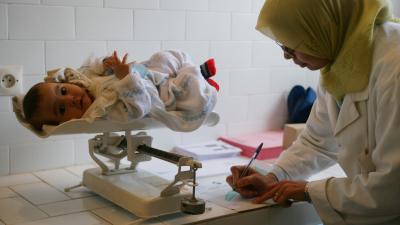
UNICEF measures children’s weight for three main reasons:
- Monitoring growth
- Screening for nutritional status
- Prescribing medicines
Accurate weight measurements are affected by several factors:
- There are currently no suitable weight scales for new-borns to children up to 12 years of age.
- The workload in many developing countries results in little or no time to weigh and record the weights of all the children, even when standard scales are available.
- The skill level of those required to take weight measurements varies widely from low literate parents to trained nurses and physicians.
- A child’s weight is often measured and documented on paper (if available) for the physician to see. Except for growth monitoring charts, there is no easy way to store child weight information for future use.
- In emergency settings worldwide, weight measurement needs to be done quickly so accurate medicine dosages are administered immediately. In these acute situations, the child may not be in a position to be moved, stand or lie on a weighing scale.
- In some situations, weight is estimated using age (if known) or height (if it can be measured) or simply guessed. It is well known that age does not correlate well with weight since the weight of children differs in different geographical regions and races.
The Challenge:
Improving the weight measurement would allow better identification of proper medicinal doses, screening of nutritional status and improve the overall identification of the health of the child. Is there a quicker, easier (fewer steps, minimal manipulation) way to measure or estimate children’s weight for developing countries? How can weight information be stored for use when needed? It’s essential that devices are suitable for developing country settings.
