Collapsible Water Containerchallenges-chat

Ensuring safe drinking water is an essential first response in any emergency situation. The collapsible water containers currently procured and distributed by UNICEF and our humanitarian cluster partners in emergencies are not easy or comfortable for familes to use.

This project seeks to develop a new collapsible water container to improve the way people collect and store water, ultimately providing better access to safe water suppies and reducing water related diseases.

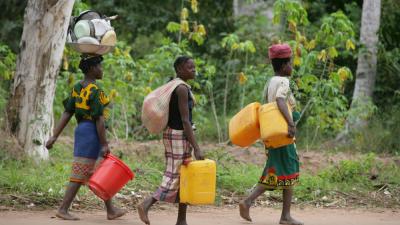
Traditional water carriers

QUICK FACTS

Start Date: 2010-01

Status:

Focus Areas: ,

Region: All

Country: All

Keywords: Jerry Can, Household water...

Overview

What are the user-needs?

The container must carry 10L of water, and be collapsible and stackable for easy packing and transportation. The container must also be easy to use - including pouring, filling, storing and carrying water. Rigidity, durability, life cycle cost and sustainability are also very important issues for consideration.

Overview of Innovation Project
  • Who initiated the project?

The UNICEF Water, Sanitation and Hygiene community and the UNICEF Supply Division (SD) Water, Sanitation & Education Centre (WSEC).

  • Why this innovation approach?

The project is a continuation of a previous project where UNICEF SD collaborated Kaos Pilots, Kolding Design School and Danish Technical University (DTU) to develop concepts for the water container challenge.

  • What is the process?

UNICEF SD’s WSEC team worked with Promens Packaging GmbH and the DTU team to develop the design for an impoved, fit-for-purpose solution, addressing the user needs.  The new design will be field tested in direct comparison to existing water containers to determine which is preferred by the end user.

  • What are the cultural considerations?

Different cultures have different means of carrying filled water containers (e.g. some carry them on their heads while others carry them on their backs).  The field testing is taking this into account by testing in 4 different countries.  

  • Next steps

The water containers are currently being field tested in the following locations:

  • CAR (Central African Republic)
  • Haiti
  • Sudan
  • Afghanistan

Meet The Team

  • Hani El-Jadaa
    UNICEF Supply
    Supply Division, Copenhagen
    Contracts Manager / WASH Unit

Current Partners/Roles

Promens Packaging GmbH

The project team are working in partnership with Promens Packaging GmbH based in Ettlingen, Germany. Their skills and experience in design and manufacturing of plastic bottles and containers has led to our successfully partnering to develop the design and produce prototypes to be tested in CAR, Sudan, Afghanistan and Haiti. We will continue to work together to evaluate the solution through the testing phase.

Promens won the contract for design and development of the concept created by DTU students Nikolai Byskov and Jon Rasmussen.

Project Updates

There are no updates for this project yet.
Resources

Concept of the 'Jerry Can'

This is an open source concept of the 'Jerry Can' produced by the UNICEF Supply Division's WSEC project team.

Prototype

Here is the first batch of prototypes received for in house testing. It was produced by the UNICEF Supply Division's WSEC project team.

Current solution in UNICEF Supply Catalogue